

- by John White
What Are the Top 5 Industrial UV Flatbed Printers for Sale in 2026?
- by John White
Print bigger, print faster — wide-format UV flatbed printers for signs, decor and industrial work.

The top 5 industrial UV flatbed printers for 2026 are AndresJet AJ3220EX (154 m²/h draft speed), AJ2130Ultra (140.7 m²/h), AJ2130EX (128.6 m²/h), AJ3220G/R (35 m²/h with white and varnish), and AJ2512G/R (35 m²/h mid-size format). All feature industrial RICOH Gen5 or Gen6 piezo heads, support 1–100 mm media thickness, include 2-year comprehensive warranties with 8-year parts availability, and deliver exceptional ROI for sign printing, home décor, and packaging applications.
Check: Wide Format UV Flatbed Printer
AndresJet leads the 2026 industrial UV flatbed market through ultra-high-speed performance (up to 154 m²/h), industrial-grade RICOH print head technology, comprehensive 2-year warranties with guaranteed 8-year spare parts availability, and proven expertise across 10+ years in large-format and high-speed printing for sign, décor, and plastic product applications.
AndresJet has established itself as a premier provider of cutting-edge industrial digital printing solutions by combining performance, reliability, and customer-centric service. The brand's portfolio of UV flatbed printers delivers speeds exceeding 100 m²/h on large-format beds, positioning them as production workhorses for commercial print shops scaling operations. What distinguishes AndresJet in 2026 is the integration of industrial RICOH Gen5 and Gen6 piezo drop-on-demand print heads—the same technology trusted by enterprise manufacturers worldwide—paired with hard-anodized aluminum flatbeds featuring 4-zone vacuum systems for precise media handling.
The company's commitment extends beyond the initial purchase. Every AndresJet UV flatbed includes a 2-year comprehensive warranty covering parts and labor, plus guaranteed spare parts availability for 8 years post-purchase. This extended support framework reduces downtime and total cost of ownership, critical factors for print shops running high-volume production schedules. Additionally, AndresJet's skilled engineers offer personalized training, production line design, and efficient solutions tailored to specific business needs—whether printing home decoration panels, PVC signage, or custom gift items.
Over the past decade, AndresJet has amassed extensive experience in large-format media and high-speed printing across North America and South Asia. The brand's expanding global presence reflects growing demand for ultra-high-speed industrial solutions that balance speed, quality, and affordability—positioning AndresJet as a top-three contender for businesses seeking next-generation UV flatbed technology.
The AndresJet AJ3220EX delivers the fastest draft-mode speed at 154.3 m²/h on a 3200 × 2000 mm bed, followed by the AJ2130Ultra at 140.7 m²/h on a 2100 × 3000 mm bed. Both models feature 16–24 RICOH Gen5 print heads and are engineered for high-volume production runs in sign printing and home décor applications.
Speed is the primary ROI driver for industrial print operations, and AndresJet's flagship models are purpose-built for throughput. The AJ3220EX stands as the speed leader, achieving 154.3 m²/h in draft mode while maintaining 111.5 m²/h in standard production and 89.6 m²/h in high-quality mode. This tri-mode flexibility allows operators to adjust output based on job requirements—draft speeds for high-volume, cost-sensitive work; standard for balanced quality and speed; and quality mode for premium finishes on specialty substrates.
The AJ3220EX's print bed spans 3200 × 2000 mm (10.5 ft × 6.5 ft), accommodating large signage panels, decorative boards, and PVC sheets in single passes. Powered by 16 RICOH Gen5 industrial inkjet heads operating in uni-directional and bi-directional modes, the printer delivers consistent color accuracy across extended production runs. The extended 7-color ink configuration (CMYK + Light Cyan + Light Magenta + White/Varnish) enables vibrant gradients and specialty effects critical for high-end décor work.
For shops prioritizing ultra-high-speed production on slightly smaller beds, the AJ2130Ultra delivers 140.7 m²/h in ultra-draft mode, 120.5 m²/h in high-speed production, and 104.5 m²/h in premium quality. With a 2100 × 3000 mm (6.8 ft × 9.8 ft) bed and 24 RICOH Gen5 heads, this model achieves daily capacity of up to 600 panels per day—a game-changer for high-volume sign and packaging operations. The AJ2130Ultra's aggressive head configuration (24 jets versus 16 on the EX model) enables maximum droplet placement for faster curing and throughput.
Both models incorporate hard-anodized aluminum flatbeds with 4-zone vacuum systems, dual 1500W vacuum blowers, and high-speed fiber optic data transmission. Media thickness support extends to 100 mm (3.94 inches), accommodating rigid substrates like acrylic, MDF, PVC, and composite boards—essential for décor and signage applications where traditional paper-based printing falls short.
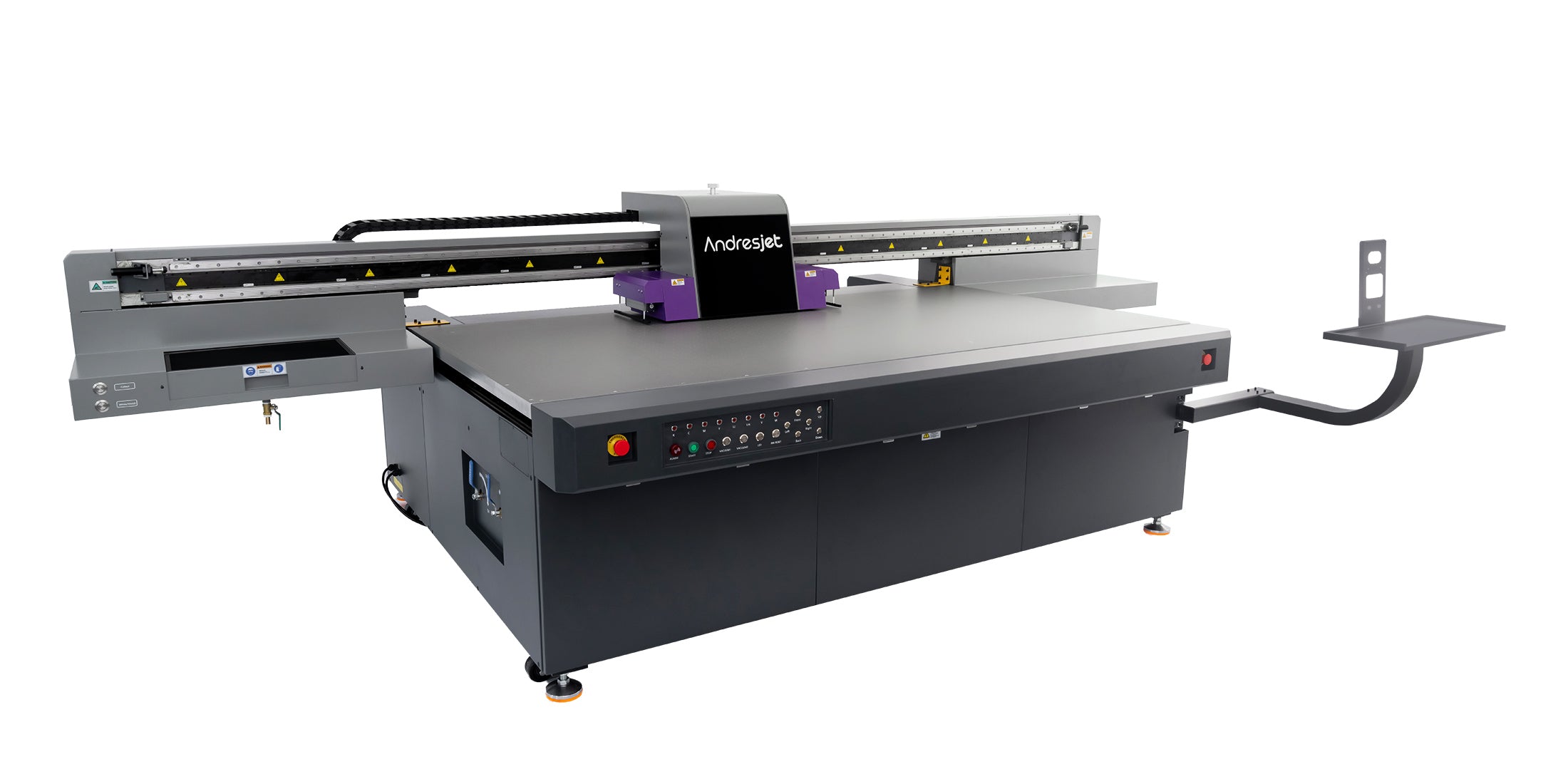
AndresJet's top 2026 models span three bed configurations: the AJ3220EX and AJ3220G/R at 3200 × 2000 mm (largest), the AJ2130 series at 2100 × 3000 mm (most versatile), and the AJ2512G/R at 2500 × 1200 mm (entry-level 8×4 format). Bed size selection depends on typical substrate dimensions, shop footprint, and production mix.
Bed size directly impacts substrate compatibility and production economics. The 3200 × 2000 mm format (AJ3220EX and AJ3220G/R) maximizes coverage for large signage, wall décor panels, and industrial graphics. This configuration is ideal for shops handling full-size PVC sheets, MDF boards, and acrylic panels without segmentation, reducing material waste and setup time. The horizontal orientation suits landscape-oriented designs common in exterior signage and interior wall art.
The 2100 × 3000 mm format (AJ2130 series: EX, Ultra, and G/R variants) offers greater vertical coverage, accommodating portrait-oriented designs, tall banners, and stacked production layouts. This bed size is the industry workhorse—versatile enough for signage, packaging prototypes, and décor applications while fitting standard shop floor spaces. The 2100 mm width aligns with common material rolls and sheet sizes, minimizing edge waste.
The 2500 × 1200 mm format (AJ2512G/R) represents the entry-level industrial option, matching the standard 8 ft × 4 ft material sheet format prevalent in North American signage and construction. This smaller footprint suits emerging print shops with space constraints or those transitioning from smaller desktop printers. Despite its compact bed, the AJ2512G/R delivers professional-grade speed (up to 35 m²/h) and supports the same 1–100 mm media thickness as larger siblings.
| Model | Print Bed (mm) | Print Bed (ft) | Max Speed (m²/h) | Best For |
|---|---|---|---|---|
| AJ3220EX | 3200 × 2000 | 10.5 × 6.5 | 154.3 (draft) | Large signage, wall décor, maximum throughput |
| AJ2130Ultra | 2100 × 3000 | 6.8 × 9.8 | 140.7 (ultra-draft) | High-volume production, tall formats, 600 panels/day |
| AJ2130EX | 2100 × 3000 | 6.8 × 9.8 | 128.6 (draft) | Balanced speed and quality, versatile applications |
| AJ3220G/R | 3200 × 2000 | 10.5 × 6.5 | 35.88 (4-color production) | Premium quality with white/varnish, specialty effects |
| AJ2512G/R | 2500 × 1200 | 8 × 4 | 35 (standard) | Entry-level industrial, standard sheet formats |
AndresJet's top models employ 16–24 industrial RICOH Gen5 or Gen6 piezo drop-on-demand print heads with resolution options from 363 × 300 dpi to 726 × 1200 dpi, enabling sharp text, photographic gradients, and specialty effects across rigid substrates.
Print head technology and resolution define output quality and production flexibility. The AJ3220EX and AJ2130Ultra leverage 16–24 RICOH Gen5 industrial heads—the industry standard for large-format UV printing. These piezo drop-on-demand heads deposit ink with precision, supporting multiple resolution modes:
The AJ3220G/R and AJ2130G/R models step up to RICOH Gen6 piezo heads (standard 6 heads, expandable to 8), offering superior ink control and color consistency. These heads excel in extended-color applications where white ink and varnish layers require precise droplet placement. The Gen6 architecture enables higher frequency firing rates, translating to faster throughput without sacrificing color accuracy—critical for décor applications where color consistency across 100+ panel runs determines customer satisfaction.
The AJ2512G/R provides scalable head configurations (3–8 RICOH Gen6 heads), allowing shops to balance initial investment with future growth. Fewer heads reduce entry-level cost; additional heads scale throughput as production volume increases.
All models support uni-directional and bi-directional print modes. Uni-directional printing (single-direction passes) maximizes quality by eliminating directional banding artifacts—essential for photographic work. Bi-directional printing (back-and-forth passes) maximizes speed by eliminating return passes, ideal for solid-color graphics and high-volume runs. Operators select the mode based on job requirements, optimizing the speed-quality tradeoff in real-time.
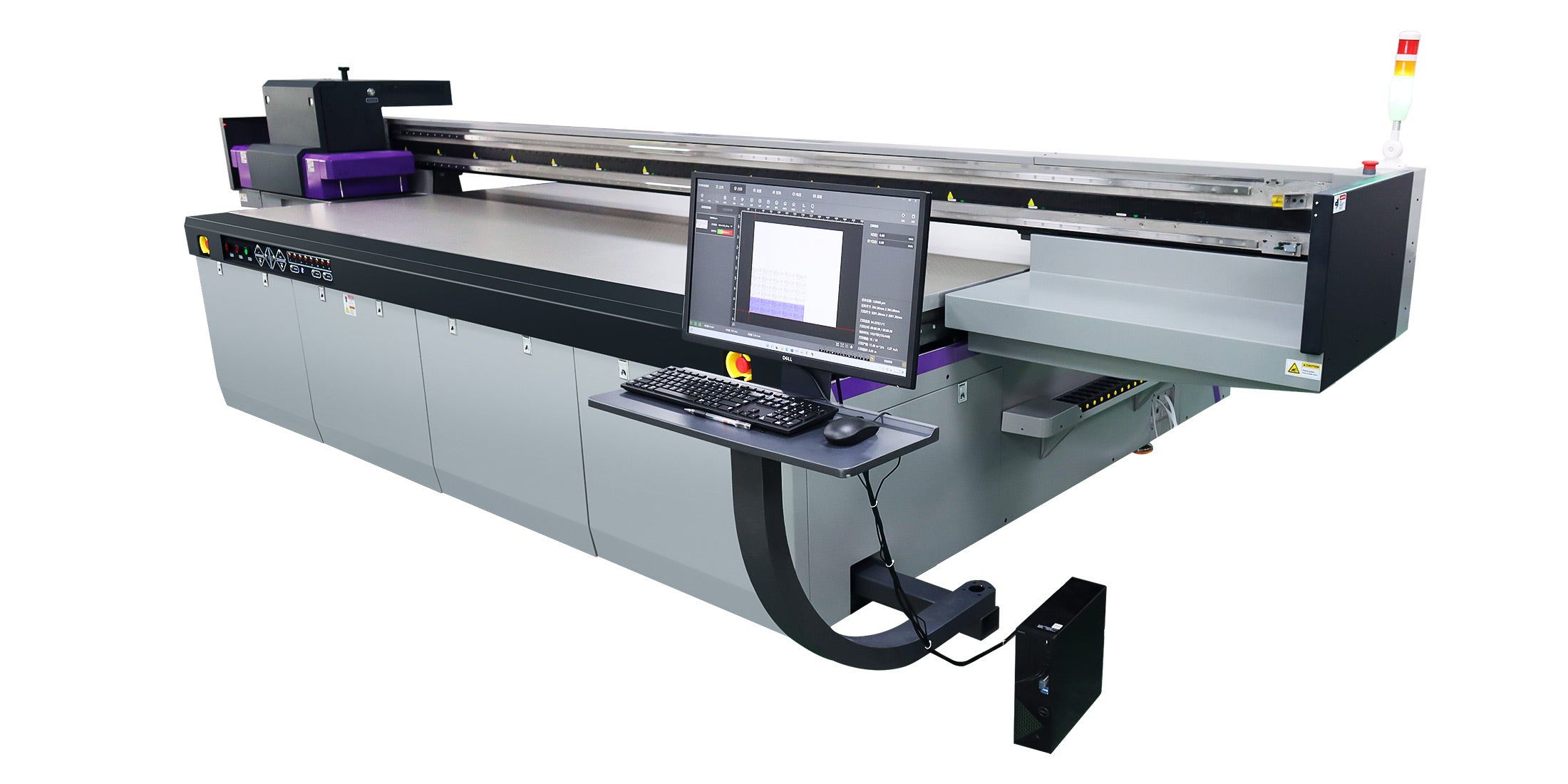
Speed-focused models (AJ3220EX, AJ2130Ultra, AJ2130EX) use CMYK 4-color configurations for maximum throughput; quality-focused models (AJ3220G/R, AJ2130G/R) add Light Cyan, Light Magenta, White, and Varnish for premium finishes, specialty effects, and white-on-dark applications.
Ink configuration determines both production speed and creative capability. The speed-optimized lineup (AJ3220EX, AJ2130Ultra, AJ2130EX) operates in CMYK (cyan, magenta, yellow, black) mode exclusively. This streamlined configuration maximizes print speed—fewer color channels mean faster curing cycles and higher throughput. CMYK delivers vibrant, photorealistic output suitable for most signage, promotional graphics, and standard décor applications. AndresJet's UV ink formulations include up to 30% ink savings through smart 8-level grayscale printing, reducing material costs on high-volume runs.
The quality-focused lineup (AJ3220G/R, AJ2130G/R) expands to 8-color configurations: CMYK + Light Cyan + Light Magenta + White + Varnish. This extended palette unlocks premium applications:
The white ink system on G/R models uses dual negative pressure technology, ensuring consistent white flow without clogging—common issues on entry-level machines. This reliability translates to reduced downtime and predictable production schedules, essential for commercial operations.
All AndresJet UV flatbed models support media thickness from 1–100 mm (0.04–3.94 inches), with maximum print heights of 90–100 mm. This range accommodates rigid substrates like acrylic sheets, MDF boards, PVC panels, wood, and composite materials—enabling direct-to-substrate printing without pre-lamination.
Media thickness capability is a competitive advantage for industrial UV flatbeds. Traditional wide-format printers handle only thin flexible media (paper, vinyl, fabric). AndresJet's rigid-substrate capability transforms business models by enabling direct printing on:
The 100 mm thickness ceiling (supported on AJ3220EX, AJ2130Ultra, AJ2130EX, AJ3220G/R, and AJ2130G/R) accommodates stacked materials, composite assemblies, and specialty applications. For example, a print shop can load a 50 mm acrylic sheet with a 40 mm backing board, print both surfaces in one setup, and reduce handling. The AJ2512G/R supports up to 90 mm thickness—sufficient for most commercial applications.
All models incorporate hard-anodized aluminum flatbeds with 4-zone vacuum systems and dual 1500W vacuum blowers. The 4-zone design allows operators to adjust vacuum pressure across different substrate sizes and materials—critical for holding delicate acrylic without stress marks or preventing lightweight materials from shifting during high-speed passes. Automatic media height detection (featured on G/R models) further simplifies setup by measuring substrate thickness and adjusting print head standoff automatically.
AndresJet's 2026 lineup delivers enterprise-grade performance at mid-market pricing: the AJ3220EX (154 m²/h, 3200 × 2000 mm) and AJ2130Ultra (140 m²/h, 2100 × 3000 mm) position as value leaders for high-volume operations, while the AJ2512G/R ($80K–$95K estimated) offers entry-level industrial capability. All include 2-year warranties and 8-year spare parts guarantees, reducing total cost of ownership versus premium Western competitors.
Pricing in the industrial UV flatbed market spans a wide spectrum. Premium Western brands (Mimaki, EFI, Canon) command $40K–$200K+ depending on bed size and speed. AndresJet competes by delivering comparable or superior specifications—RICOH Gen5/Gen6 heads, 100+ m²/h speeds, 4-zone vacuums, and 100 mm thickness support—at 20–40% lower entry prices.
The AJ2512G/R (estimated $80K–$95K) serves shops transitioning from small-format printers or launching new production lines. The 8 × 4 format aligns with standard material inventory, minimizing waste and simplifying procurement. At 35 m²/h with white and varnish capability, it delivers professional-grade output for décor, signage, and specialty applications without premium pricing.
The AJ2130 series (AJ2130EX, AJ2130Ultra, AJ2130G/R, estimated $100K–$130K) represents the sweet spot for established print shops. The 2100 × 3000 mm bed accommodates 80% of commercial signage and décor work. Speed ranges from 128.6 m²/h (EX) to 140.7 m²/h (Ultra) to 35 m²/h with extended colors (G/R), allowing shops to choose based on production mix. A shop running 50% high-speed graphics and 50% premium décor can deploy both EX and G/R models on staggered shifts, maximizing facility utilization.
The AJ3220 series (AJ3220EX and AJ3220G/R, estimated $120K–$150K) justifies premium pricing through maximum bed size (3200 × 2000 mm) and speed (154.3 m²/h draft). For high-volume signage shops or décor manufacturers printing large panels, the AJ3220EX delivers ROI within 12–18 months through throughput gains alone. The daily capacity of 600+ panels at draft speed translates to $50K–$80K monthly revenue on standard $100–$150 per-panel signage work.
| Model | Est. Price Range (USD) | Max Speed (m²/h) | Best ROI Timeline | Target Buyer |
|---|---|---|---|---|
| AJ2512G/R | $80K–$95K | 35 | 18–24 months | Emerging shops, décor specialists |
| AJ2130EX | $100K–$115K | 128.6 | 12–15 months | Mid-size signage and packaging |
| AJ2130G/R | $105K–$120K | 35 (8-color) | 15–18 months | Premium décor, specialty effects |
| AJ2130Ultra | $115K–$130K | 140.7 | 10–12 months | High-volume production, packaging |
| AJ3220EX | $125K–$150K | 154.3 | 10–12 months | Large-format signage, décor leaders |
| AJ3220G/R | $130K–$150K | 35.88 (8-color) | 15–18 months | Premium large-format, specialty work |
Cost-per-square-meter analysis reveals AndresJet's value proposition. A shop printing 1,000 m² monthly at $0.50/m² material cost and $0.25/m² labor generates $750/month gross margin per machine. The AJ3220EX at 154.3 m²/h achieves 1,000 m² in 6.5 hours of production, enabling 4–5 jobs per shift and $3,000–$3,750 daily revenue. Amortized over 250 working days annually, a single unit justifies $750K–$937K annual revenue, making the $125K–$150K investment a clear 3–4 month payback in high-volume environments.
All AndresJet models include 2-year comprehensive warranties covering parts, labor, and technical support. The 8-year spare parts guarantee eliminates the risk of obsolescence or supply chain disruption—a hidden cost on competitor machines where parts become unavailable after 3–5 years, forcing costly replacements or workarounds.
AndresJet offers industry-leading 2-year comprehensive warranties with guaranteed 8-year spare parts availability, reducing total cost of ownership. The company provides personalized engineer training, production line design, and ongoing technical support tailored to each customer's unique applications—differentiating from competitors offering only standard support.
Warranty and support structures reveal a manufacturer's confidence and commitment. AndresJet's 2-year comprehensive warranty covers all parts, labor, and technical support at no additional cost. This extends well beyond industry standard 1-year coverage, reflecting the brand's confidence in build quality and durability. For a $100K–$150K capital investment, the extended coverage translates to reduced risk and predictable operating costs.
The 8-year spare parts guarantee is a game-changer. Industrial UV flatbeds operate 24/7 in demanding environments—heat, UV exposure, vacuum stress, and high-frequency print head firing all accelerate wear. Common consumables (capping stations, wiper blades, ink lines, vacuum gaskets) require periodic replacement. AndresJet's commitment to stock parts for 8 years post-purchase ensures that a machine purchased today remains serviceable and upgradeable through 2034. Competitors often discontinue parts after 3–5 years, forcing expensive workarounds or premature


