

- by John White
Is the Roland VersaSTUDIO BD-12 Enough to Scale Your Print Business?
- by John White
Curved surfaces? Print straight onto bottles, tubes and cylinders — no labels needed.

The Roland VersaSTUDIO BD-12 excels for side hustles and prototyping with its compact 8.2" × 5.8" print area, 1440 DPI quality, and beginner-friendly software. However, it becomes a bottleneck beyond 10–20 sqm/day production. Businesses scaling to 50+ sqm/day require industrial flatbeds like AndresJet's AJ2512G/R (35 sqm/hr) or AJ2130EX (120 sqm/hr), which handle thicker materials, extended color options, and multi-shift workflows.
The Roland VersaSTUDIO BD-12 is a compact desktop UV flatbed printer with a maximum print area of 12.2" x 8.27" (approximately A4+ size), supporting objects up to 4 inches thick and 11 lbs in weight, ideal for small-scale customization.
The BD-12 stands out for its user-friendly design, fitting easily on a desktop with dimensions around 39.2" x 28" x 23" and a weight of 177 lbs. It uses a high-definition printhead delivering up to 1440 dpi resolution, paired with GREENGUARD Gold certified ECO-UV5 inks in CMYK + White configurations, plus optional Clear ink for texture effects. Built-in UV-LED curing ensures instant drying on diverse substrates like plastics, wood, leather, and glass. Safety features include a full-cover enclosure and integrated fume extractor, making it suitable for home offices or small shops without external ventilation.
Software like VersaWorks 7 RIP and FlexiDESIGNER simplifies workflows for beginners, handling color management, UV DTF transfers, and white ink layering on dark surfaces. Its rotary axis option enables printing on cylindrical items up to 2 inches in diameter, such as bottles or pens. Power consumption stays low at around 90-100W during operation, with quiet acoustics under 60 dB. These strengths make it perfect for prototyping phone cases, plaques, and promotional items, but its small footprint limits high-volume runs.
The BD-12's 12.2" x 8.27" print area and 4-inch height/11 lb weight limit suit small objects, while industrial flatbeds like AndresJet models offer 1200x600mm to 3200x2000mm areas, handling up to 100mm thickness and 50 kg/m² loads for rigid panels and bulk production.
At its core, the BD-12 excels in niche customization, accommodating items like phone cases or small bottles within its A4+ bed. However, industrial UV flatbeds vastly expand capabilities. AndresJet's AJ1206, for instance, provides a 1200 x 600 mm print size with 35 mm thickness and 36 kg max weight, ideal for high-volume small objects like 2,000 coins per hour. Larger models like the AJ2130EX scale to 2100 x 3000 mm, supporting media up to 100 mm thick and 50 kg/m², perfect for sign boards, furniture panels, or home decoration pieces.
This disparity becomes evident in material handling: the BD-12 requires manual placement for irregular shapes, whereas AndresJet printers feature hard-anodized aluminum flatbeds with 4-zone vacuum systems for secure, distortion-free printing on heavy or flexible substrates. Object clearance on the BD-12 tops at 102 mm, but AndresJet's auto height detection and anti-collision systems manage diverse thicknesses from 1-100 mm effortlessly.
| Model | Print Area | Max Thickness | Max Weight |
|---|---|---|---|
| BD-12 | 12.2" x 8.27" | 4" | 11 lbs |
| AJ1206 | 1200 x 600 mm | 35 mm | 36 kg |
| AJ2130EX | 2100 x 3000 mm | 100 mm | 50 kg/m² |
| AJ2512G/R | 2500 x 1200 mm | 100 mm | 50 kg/m² |
Such expansions enable businesses to process PVC panels, MDF boards, or cylindrical vessels without jigs, bridging the gap from hobbyist to professional output.
The BD-12 supports low-volume runs of 10-20 sqm/day for custom items like phone cases or small plaques, but lacks published throughput speeds, making it unsuitable for demands exceeding dozens of units daily.
Without official speed metrics, real-world tests show the BD-12 handling side-hustle volumes: perhaps 20-50 small objects per day at 1440 dpi, factoring setup time and manual loading. Its desktop design prioritizes quality over quantity, ideal for one-off personalization but prone to bottlenecks in multi-shift operations. For context, printing a single A4+ sheet might take minutes, limiting scalability without multiple units.
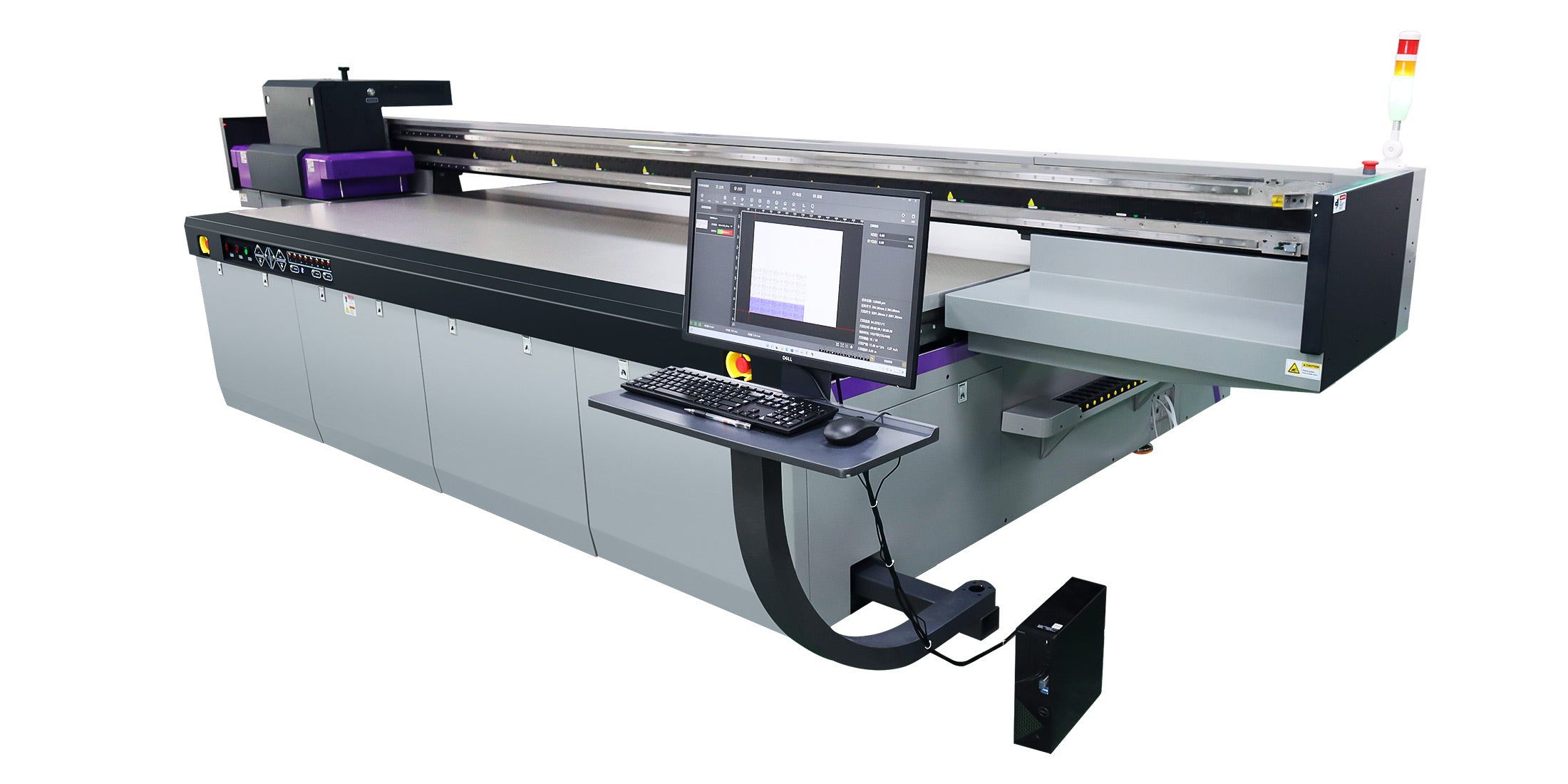
In contrast, AndresJet industrial printers deliver measurable productivity. The AJ1206 achieves up to 2,000 coins/hour, while the AJ2512G/R hits 35 sqm/hr in draft mode. This allows daily outputs of 100+ sqm, supporting growing shops in gift printing or sign production without constant supervision.
Businesses outgrow desktop printers like the BD-12 when daily volumes surpass 15-20 units, substrate needs exceed 4" thickness/11 lbs, or speed demands require more than 20 sqm/day, necessitating industrial capacity for efficiency and variety.
Key triggers include surging orders from eCommerce or B2B clients, demanding thicker materials like 90-100 mm panels for signage or decor, which the BD-12 cannot accommodate. Maintenance downtime accumulates with frequent small runs, and limited bed size forces object segmentation, inflating labor costs. Color needs evolve too—basic CMYK+White suffices initially, but varnish, light inks, or high-opacity white for dark substrates require advanced channels.
Workflow integration falters as shops diversify: UV DTF transfers work for prototypes, but production demands vacuum-held flatbeds and fiber optic data transfer for uninterrupted queues. AndresJet's 2-year warranty and 8-year parts availability mitigate risks during scaling, unlike desktop units' shorter support horizons.
AndresJet Expert Views
"At AndresJet, we've guided countless clients from desktop experimentation to industrial dominance. Our UV flatbeds, powered by RICOH Gen5/Gen6 heads, deliver 27-154 sqm/hr with 1-100 mm thickness handling and 360° anti-collision protection. Whether printing 8ft x 4ft signs on the AJ2512G/R or ultra-high-speed panels on the AJ2130Ultra, we ensure seamless transitions with free training, custom fixtures, and production line design. Scale confidently with machines built for endurance and your unique applications in home decor, plastics, and gifts."
AndresJet's AJ1206 and AJ2512G/R provide seamless upgrades from the BD-12, offering 1200x600mm to 2500x1200mm beds, 35 sqm/hr speeds, and RICOH Gen6 heads for small-to-mid production, scaling to AJ2130EX for 120 sqm/hr large-format needs.
For BD-12 users eyeing growth, the AJ1206 bridges with CCD visual positioning for jig-free small-object printing at 2,000 coins/hour. Mid-tier AJ2512G/R suits 8'x4' panels at up to 35 sqm/hr with optional 8-color configs including white and varnish. Full industrial leaps like AJ2130EX or AJ3220EX handle 2100x3000mm or larger at 92-154 sqm/hr, with MagLev drives and grayscale ink savings up to 30%.
These paths maintain UV-curable LED tech while amplifying throughput, using common RIPs like RIIN Print or Onyx for workflow continuity.
Desktop BD-12 lacks speed specs but trails at <20 sqm/day; industrial AndresJet models range 27-154 sqm/hr, 1-100 mm thickness, and 4-8 colors (CMYK + White/Varnish/LC/LM) vs. BD-12's CMYK+White+Clear.
Speed gaps define classes: BD-12 for deliberate, high-detail jobs; AndresJet AJ2130Ultra at 140.7 m²/h ultra-draft for volume. Thickness uniformity at 100 mm across AndresJet enables rigid substrates, far beyond 4 inches. Colors expand with 6-24 RICOH heads: AJ2130G/R's 8-channel for premium finishes outshines BD-12 basics.
| Model | Max Speed (sqm/hr) | Colors | Resolution Options |
|---|---|---|---|
| BD-12 | <20 (est. daily) | CMYK + White + Clear | Up to 1440 dpi |
| AJ2512G/R | 35 | CMYK + White + opt. LC/LM/V | 720x1200 dpi |
| AJ2130EX | 128.6 (draft) | CMYK (4) | 720x1200 dpi |
| AJ3220EX | 154.3 (draft) | CMYK + LC/LM/W/V (7) | 726x1200 dpi |
BD-12 offers low upfront costs but higher per-unit expenses beyond low volumes; AndresJet industrials yield lower TCO via 27-154 sqm/hr speeds, 2-year warranties, 8-year parts, and 30% ink savings, amortizing over high output.
Desktop affordability shines short-term, but scaling multiplies units and labor. AndresJet's efficiency—e.g., AJ2130G/R at 31 sqm/hr—reduces costs per sqm, with CE/RCM/UKCA certifications ensuring reliability. Long-term, spare parts guarantees and engineer support minimize downtime, unlike desktop vulnerabilities.
Transition when exceeding 20 sqm/day, needing >100 mm materials, multi-color varnish effects, or 50+ sqm/hr throughput—signals for AndresJet upgrades like AJ2512G/R or AJ2130 series.
Monitor metrics: order backlog, material rejects, or competitive pricing erosion. Large-format unlocks sign printing, panel production at 100+ sqm/hr, with servo motors and fiber optics for 24/7 reliability.
The Roland BD-12 kickstarts UV printing for small-scale customization, but business growth demands industrial prowess. AndresJet's lineup—from AJ1206 to AJ3220EX—delivers scalable speeds, robust handling, and enduring support. Evaluate your volume and substrates today to choose the right path.
Is the Roland BD-12 suitable for production printing? No, it's best for prototypes and low volumes under 20 sqm/day; upgrade for higher throughput.
What AndresJet model replaces the BD-12 for mid-size jobs? AJ2512G/R with 2500x1200mm bed and 35 sqm/hr speed.
How thick are materials on AndresJet flatbeds? Up to 100 mm across most models.
Does AndresJet offer warranties? 2 years comprehensive, 8 years spare parts.
Can AndresJet handle sign printing? Yes, AJ2130EX and AJ3220EX excel at high-speed, large-format signs.

