

- by John White
How to Master ICC Color Profiles for UV Flatbed Printing?
- by John White
Print bigger, print faster — wide-format UV flatbed printers for signs, decor and industrial work.

ICC color profiles for UV flatbed printing ensure consistent color reproduction across devices and substrates by defining device-specific color gamuts in CMYK, white ink, and varnish setups. Use RIIN Print or Onyx RIP on AndresJet printers like AJ2130G/R: 1) Calibrate with spectrophotometer; 2) Generate profiles via grayscale and density adjustments; 3) Apply G7 standards for 15-20% waste reduction in high-speed runs over 100 sqm/hr.
Check: how can you adjust print settings for optimal color saturation
ICC profiles are data files that characterize a printer's color behavior, mapping device-specific colors to a standard color space like CIELAB for accurate reproduction across monitors, printers, and substrates. In UV flatbed printing, they ensure vibrant, consistent output on rigid materials like PVC and MDF, minimizing waste in high-volume sign and gift production.
International Color Consortium (ICC) profiles act as translators between color spaces, defining how a printer renders CMYK, white ink, or varnish on specific media. For industrial UV flatbeds, they bridge the gap between design software and output, accounting for ink-substrate interactions unique to LED UV curing. Without them, colors shift due to media absorption or ink density variations, leading to rejects in brand-critical applications like signage.
In high-speed UV flatbed workflows exceeding 100 sqm/hr, ICC profiles maintain gamut fidelity, enabling precise saturation and tone curves. AndresJet UV flatbed printers, such as the AJ2130EX with speeds up to 128.6 m²/h in draft mode, integrate ICC-based color management directly via RIIN Print or PhotoPrint RIP software, supporting resolutions like 720×1200 dpi for sharp, color-accurate prints on media up to 100 mm thick.
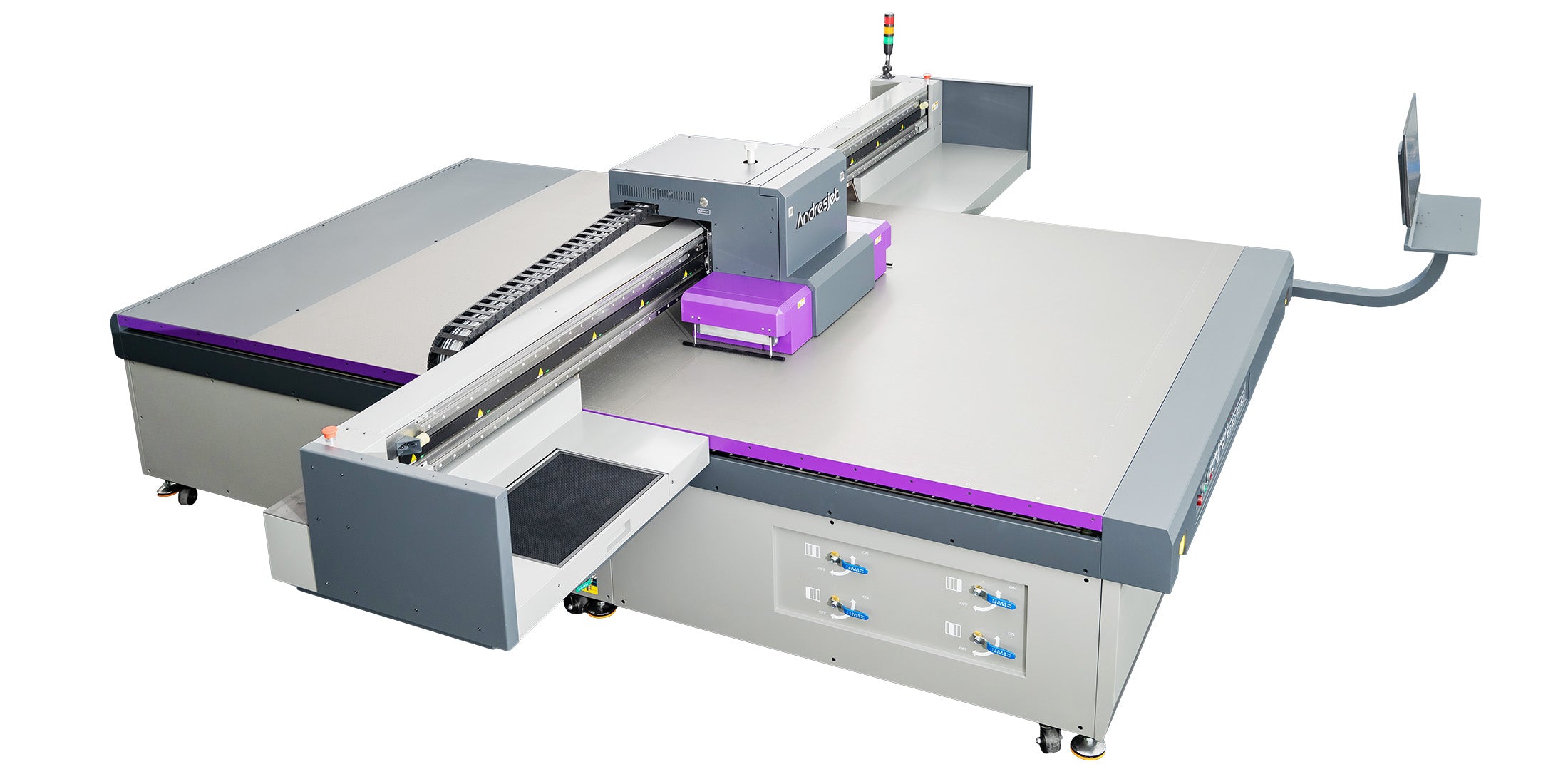
Color management in high-speed printers uses ICC profiles, RIP software curves, and density adjustments to convert design colors to printer instructions, compensating for speed-induced drift and substrate variations. AndresJet models like AJ2130Ultra achieve this with fiber optic data transmission and smart grayscale printing for up to 30% ink savings at 140.7 m²/h ultra-draft speeds.
High-speed industrial printers process color through a pipeline: input profiles convert RGB/CMYK to Profile Connection Space (PCS), then output profiles map to device-specific values. RIP software like Onyx or RIIN Print handles linearization, ensuring even ink laydown during bi-directional or uni-directional modes.
For UV flatbeds, this is critical at production rates over 100 sqm/hr, where heat and velocity can alter curing. AndresJet's AJ3220EX, with 16 RICOH GEN5 heads and 154.3 m²/h draft speed, uses 4-zone vacuum flatbeds and anti-collision systems alongside ICC profiles to deliver consistent density on 50 kg/m² media loads.
| Model | Draft Speed (m²/h) | Standard Speed (m²/h) | Key Color Feature |
|---|---|---|---|
| AJ2130EX | 128.6 | 92.9 | Smart 8-level grayscale |
| AJ2130Ultra | 140.7 | 120.5 | High-velocity CMYK |
| AJ3220EX | 154.3 | 111.5 | Extended 7-color |
RIIN Print, PhotoPrint, and Onyx provide superior ICC support for AndresJet printers, enabling profile import, linearization, and media-specific adjustments for white ink and varnish. These integrate seamlessly with RICOH GEN5/GEN6 heads, supporting TIFF, JPEG, EPS, and PDF formats for precise color mapping.
AndresJet UV flatbeds come equipped with RIP options tailored for industrial use: RIIN Print excels in high-speed workflows with density curves; PhotoPrint offers advanced gamut mapping; Onyx provides robust G7 compliance tools. Selection depends on needs—RIIN Print for AJ2130G/R's 8-color setups (CMYK + LC + LM + White + Varnish), Onyx for AJ2512G/R's scalable 3-8 heads.
These RIPs automate ICC application, reducing manual tweaks. For example, in AJ3220G/R with up to 35.88 m²/h standard production, Onyx's spot color matching ensures Pantone accuracy on 90 mm thick media.
AndresJet Expert Views: "Our engineers recommend starting with RIIN Print for its native integration with AJ2130 series printers, where ICC profiles and curves handle white ink layering up to 0.15mm raised effects. Combined with 360° anti-collision and fiber optic interfaces, this delivers production-ready color accuracy at over 100 sqm/hr without downtime. For signage and gifts, G7-calibrated profiles in PhotoPrint cut waste by 15-20%, ensuring brand consistency across North America and South Asia runs." — AndresJet Technical Director
Calibrate white ink and varnish using a spectrophotometer to print test charts, measure L*a*b* values, and build ICC profiles in RIP software, adjusting density for undercolor removal and opacity. AndresJet's AJ2130G/R supports this with four white channels and auto height detection up to 100 mm.
Step 1: Print a target chart via RIP (no color management). Step 2: Measure dried patches post-UV curing. Step 3: Generate profile in RIIN Print, applying curves for white underbase. Step 4: Soft-proof in design software. For varnish, linearize gloss layers separately. AndresJet models like AJ1206 with 8 colors (CMYK + W + V + Lc + Lm + LK) excel here, achieving 0.01 mm positioning accuracy.
G7 compliance involves 1) Linearizing gray balance via test wedges; 2) Applying ICC profiles with perceptual rendering; 3) Verifying with inline spectrophotometers for neutral grays across substrates. This standardizes UV printing for predictable results in high-volume signage.
G7 methodology unifies tone curves regardless of device. In AndresJet printers, use RIP tools to achieve 1D LUT linearization, then 3D LUT for gamut. For AJ3220EX's 7-color configs, this prevents color drift in bi-directional modes at 726×1200 dpi.
Check: Color Management & ICC
Create profiles by printing substrate-specific targets on PVC, ABS, or MDF, measuring with a spectrophotometer, and building ICC files in RIP software accounting for ink spread and curing. AndresJet flatbeds handle 1-100 mm thickness with 4-zone vacuum for stable profiling.
For PVC/ABS plastics, use higher density settings to counter gloss; MDF requires matte adjustments. Workflow: Select media in RIIN Print, print patches, analyze in profiling software. AJ2512G/R's THK LM Guides ensure precise registration for 8ft × 4ft panels.
| Substrate | Key Adjustment | AndresJet Model Fit | Max Thickness |
|---|---|---|---|
| PVC | Increased density | AJ2130G/R | 100 mm |
| ABS | Gloss compensation | AJ3220G/R | 90 mm |
| MDF | Matte curves | AJ2130EX | 100 mm |
Color drift in high-speed runs stems from ink velocity, heat buildup, or vacuum inconsistencies; fix with periodic recalibration, inline density checks, and G7 profiles. AndresJet's anti-static bars and redesigned capping minimize this at 120+ sqm/hr.
At speeds like AJ2130Ultra's 104.5 m²/h premium quality, servo motors and IGUS e-chains maintain stability. Recalibrate every 8 hours or 100 sqm; use closed-loop verification for white ink consistency in gift printing.
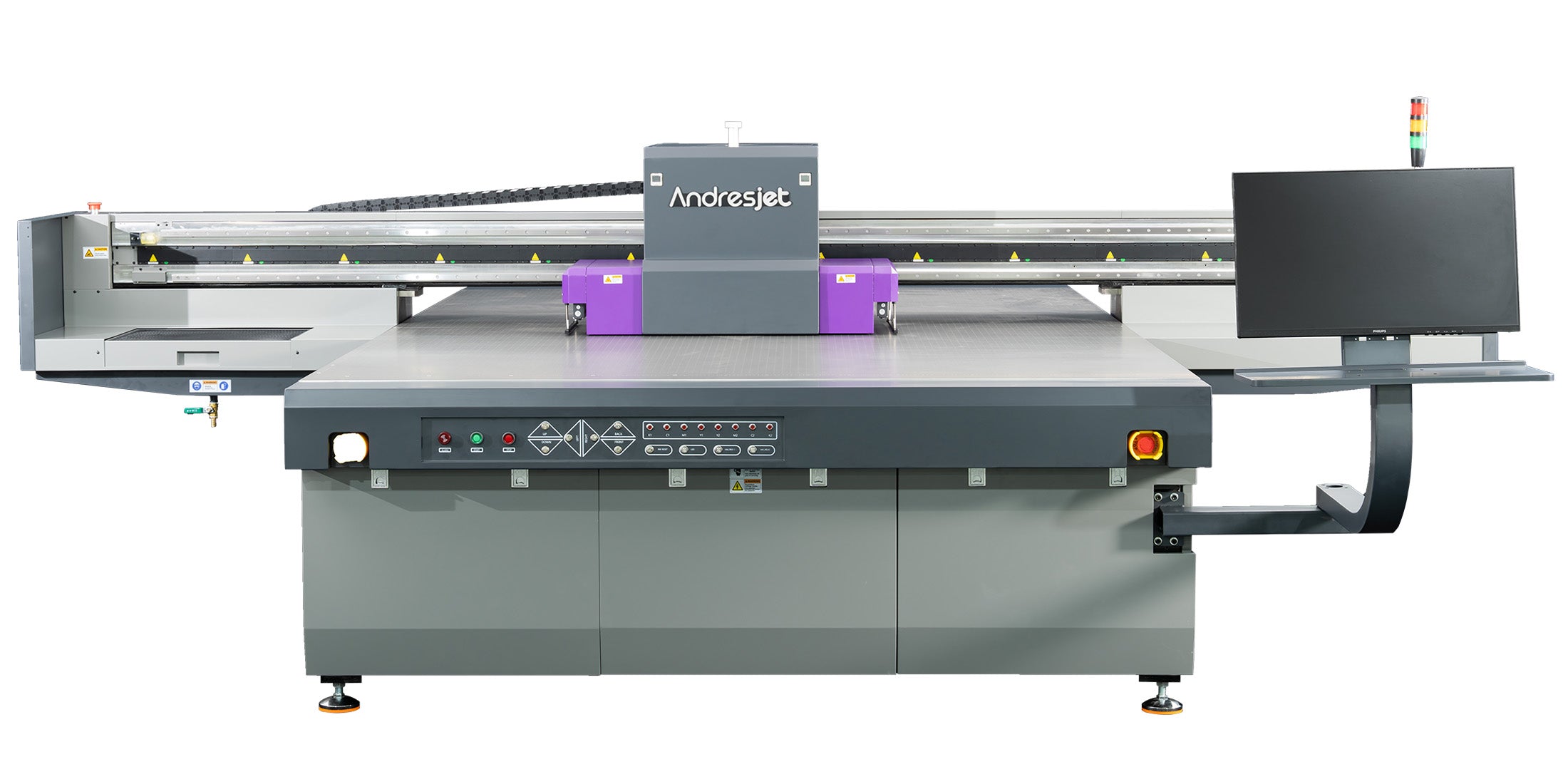
AJ2130G/R, AJ3220G/R, and AJ2130EX excel with ICC support via RIIN Print/Onyx, extended color configs, and resolutions up to 720×1200 dpi for signage/gifts on diverse media. All feature 2-year warranties and 8-year parts.
AJ2130G/R offers 8 colors at 34.9 m²/h standard; AJ3220G/R hits 35.88 m²/h with expandable heads. Ideal for brand consistency in home decor and plastic printing.
Mastering ICC profiles elevates UV flatbed output, ensuring color accuracy and efficiency. AndresJet's high-speed printers with integrated RIP color management deliver reliable results for global production needs. Download free substrate-specific ICC profiles at AndresJet.com and explore models like AJ2130Ultra today.
What is the best RIP for AndresJet color management? RIIN Print or Onyx for seamless ICC integration and high-speed accuracy.
How often to recalibrate UV flatbed colors? Every 8-10 hours or 100 sqm in production runs.
Can ICC profiles handle white ink on clear acrylic? Yes, with dedicated underbase profiling in AJ2130G/R.
What reduces waste in sign printing? G7-compliant ICC setup cuts rejects by 15-20%.


