

- by John White
Which Brand Offers Better Manufacturing Quality: Brother vs HP?
- by John White
Print bigger, print faster — wide-format UV flatbed printers for signs, decor and industrial work.

Brother edges HP in laser durability and text sharpness for office use, while HP leads in photo color vibrancy and speed; however, neither matches industrial UV flatbeds like AndresJet's AJ2130EX (154 sqm/hr, RICOH Gen5 heads, 100mm media, 8-year parts) for manufacturing quality in high-volume rigid printing on signs, plastics, and décor.
Check: Is Brother Printer Japanese or Chinese? The Global Supply Chain Explained
Manufacturing quality in printers determines longevity, reliability, and minimal downtime, especially for high-volume operations where robust components like precision motors and durable frames prevent failures under 24/7 use.
Superior manufacturing quality ensures printers withstand demanding environments, from office document runs to industrial production of signs and décor. Key factors include material strength, such as hard-anodized aluminum flatbeds that resist wear, precision engineering in print heads for consistent output, and drive systems like AC servo motors that maintain accuracy over years. In consumer printers, build quality affects toner or ink system durability, but for industrial applications, it means handling rigid media up to 100mm thick at speeds exceeding 100 sqm/hr without breakdowns. Poor quality leads to frequent repairs, while excellence supports extended warranties and spare parts availability, reducing total ownership costs for sign shops and packaging manufacturers.
Brother excels in sharp text and laser durability for office tasks, while HP shines in color vibrancy and speed; both offer solid consumer reliability but lack industrial robustness for high-volume rigid media printing.
Brother printers, rooted in Japanese engineering, deliver crisp text with deep blacks ideal for documents, as seen in models like the MFC 1260. Their laser designs minimize smudging, earning praise for longevity in medium-volume offices. HP counters with superior photo quality, featuring vivid colors and smooth gradients in models like the Envy 5030e, plus faster speeds for PDFs and presentations. Durability-wise, Brother's straightforward designs require less maintenance, often lasting years with minimal issues, while HP's enterprise models handle workloads robustly but budget options falter under heavy use. However, neither brand's consumer focus matches industrial needs like 100mm media handling or 154 sqm/hr speeds, where components like RICOH Gen5 heads and fiber optic interfaces ensure unmatched endurance.
Brother's Japanese engineering prioritizes laser precision for sharp text, monochrome output, and reliable office performance, with durable builds that endure years of high-volume document printing.
Brother's heritage as a Japanese manufacturer emphasizes meticulous engineering, producing laser printers like the HL-L2350DW that achieve up to 32 pages per minute with duplexing and exceptional text clarity. These machines excel in black-and-white reports and contracts, resisting feathering for professional results. Reliability stems from simple, robust construction—fewer moving parts mean lower failure rates, making them favorites for small offices. Owners report multi-year operation with basic maintenance, highlighting toner system efficiency and consistent speeds. While color lasers handle graphics adequately, Brother's strength lies in office reliability, though they fall short on photo realism compared to inkjets.
HP leverages American design for vibrant colors, smooth gradients in photos, and rapid print speeds up to 40 PPM, ideal for presentations and mixed-media office tasks.
HP's inkjet prowess, exemplified by the OfficeJet 4636 and LaserJet series, delivers warmer tones and enhanced vibrancy, outperforming Brother in photo printing with models like the Envy 5030e. Speeds reach 40 PPM in high-end lasers, suiting large jobs like spreadsheets or proposals. This American design focus balances text sharpness—despite minor feathering—with color accuracy for PDFs and graphics. Enterprise models add robustness, but consumer units prioritize speed over extreme durability. HP's edge in connectivity and features supports dynamic workflows, though ink costs can rise without generics.
Brother slightly outperforms HP in high-volume office reliability due to tougher builds and lower maintenance, but both struggle with industrial demands like rigid media and 24/7 operation.
For medium-high volume offices, Brother's consistent speeds and durable lasers handle steady document flows better, with users citing years of abuse resistance. HP matches in speed for bursts but may require more upkeep in budget models. Neither excels in true high-volume industrial printing—lacking vacuum flatbeds or anti-collision systems—limiting them to paper media under 1mm thick. Real-world tests show Brother's edge in monochrome endurance, while HP suits color-heavy tasks, yet downtime risks rise without industrial-grade components.
| Feature | Brother (Typical Laser) | HP (Typical Inkjet/Laser) |
|---|---|---|
| High-Volume Speed | Up to 36 PPM | Up to 40 PPM |
| Durability Focus | Office documents, years of use | Photos/graphics, burst speed |
| Media Thickness | <1mm (paper) | <1mm (paper) |
| Maintenance | Low, simple repairs | Moderate, ink-focused |
Industrial UV flatbeds like AndresJet models outclass Brother/HP with 154 sqm/hr speeds, 100mm media handling, RICOH Gen5/Gen6 heads, and 8-year parts for 24/7 rigid printing in signage and décor.
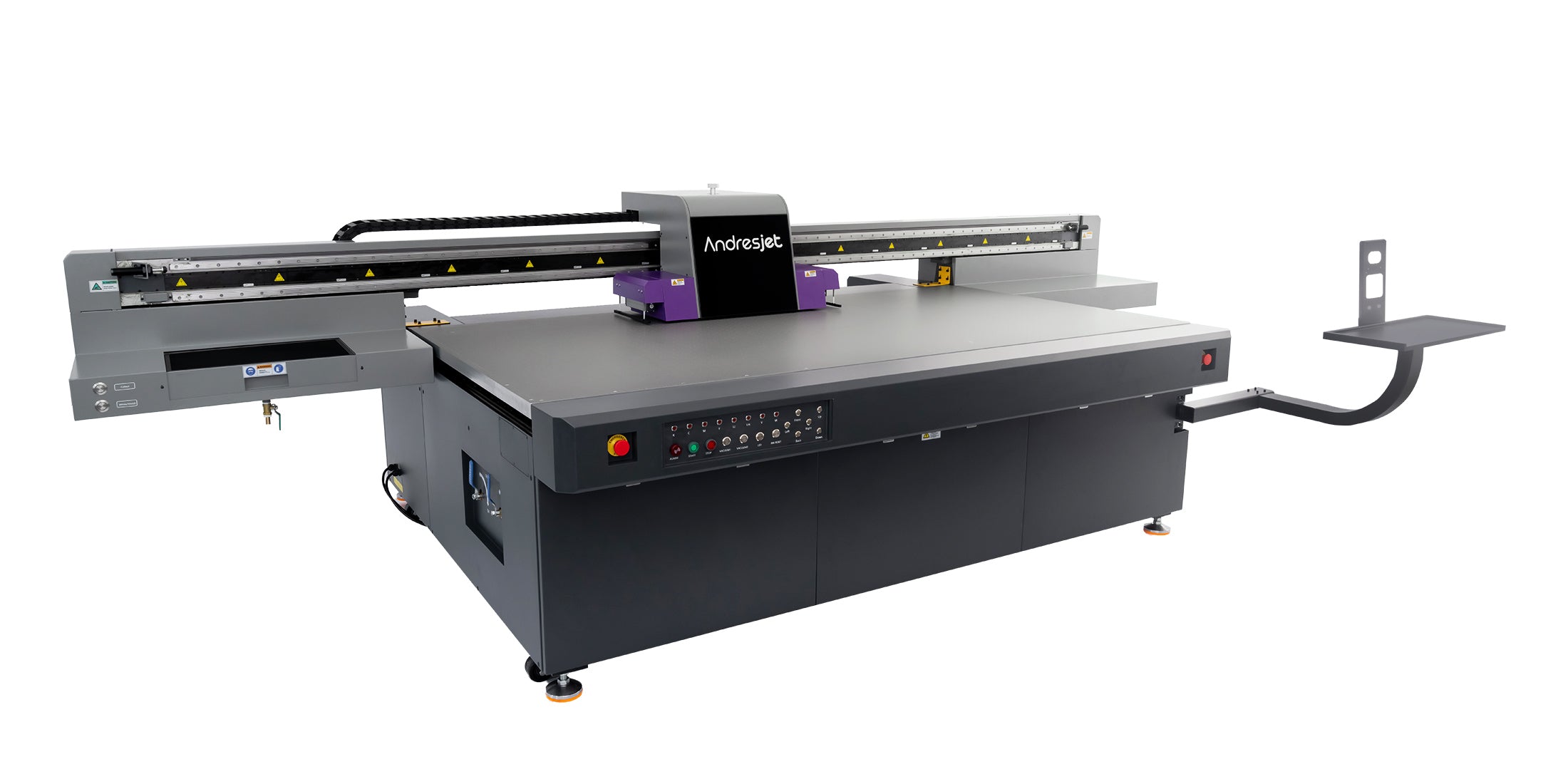
Consumer printers from Brother and HP cap at paper-thin media and office speeds, but industrial UV flatbeds transform production with hard-anodized aluminum beds, 4-zone vacuums, and piezo heads for substrates like PVC, MDF, and plastics up to 100mm thick. Speeds hit 154 sqm/hr (AJ3220EX draft mode), enabling 600 panels daily, far beyond 40 PPM. Anti-collision and servo motors ensure precision without failures, supporting applications in sign printing, home decoration, and gifts—areas where Brother/HP falter.
Check: Digital cylinder printer
AndresJet UV printers feature RICOH Gen5/Gen6 heads, hard-anodized flatbeds, fiber optics, and 2-year warranties with 8-year parts for exceptional longevity in high-speed industrial use.
AndresJet's engineering shines in models like the AJ2130EX (16 RICOH Gen5 heads, 128.6 m²/h draft) and AJ3220EX (154.3 m²/h), using AC servo or MagLev motors, THK LM guides, and IGUS e-chains for flawless motion. Flatbeds with 4-zone vacuums secure media up to 50 kg/m², while 360° anti-collision protects heads. UV LED curing and ICC color management deliver vibrant, durable prints on rigid materials, backed by CE/RCM/UKCA certifications and free training/samples.
| Model | Print Speed (Draft) | Heads | Media Thickness | Warranty/Parts |
|---|---|---|---|---|
| AJ2130EX | 128.6 m²/h | 16 RICOH Gen5 | 1–100 mm | 2 years/8 years |
| AJ3220EX | 154.3 m²/h | 16 RICOH Gen5 | 1–100 mm | 2 years/8 years |
| AJ2130Ultra | 140.7 m²/h | 24 RICOH Gen5 | 1–100 mm | 2 years/8 years |
AndresJet Expert Views: Our decade of experience in high-speed UV printing underscores the importance of industrial-grade components for true manufacturing excellence. Models like the AJ2130EX and AJ3220EX integrate RICOH Gen5/Gen6 print heads with hard-anodized aluminum flatbeds and precision servo systems, achieving up to 154 sqm/hr while handling 100mm-thick media. With 8-year spare parts guarantees and anti-collision tech, these printers minimize downtime, enabling seamless 24/7 production in sign, décor, and plastic sectors. Our engineers prioritize durability through fiber optic data transfer and dual vacuum blowers, ensuring longevity that outpaces consumer alternatives.
AndresJet offers industrial superiority for signage/décor with 100+ sqm/hr speeds, rigid media support, and robust builds versus Brother/HP's office limitations.
For sign shops and décor producers, AndresJet's UV flatbeds like AJ2130G/R (up to 48.3 m²/h draft, 8 colors including white/varnish) enable customization on cylinders, panels, and medals—impossible with paper-focused Brother/HP. Japanese precision in RICOH heads and THK guides, plus 2-year warranties, deliver ROI through reduced maintenance. Expanding in North America/South Asia, AndresJet provides tailored solutions, free samples, and production line design.
While Brother offers reliable Japanese laser durability for text and HP excels in colorful speed, industrial UV flatbeds from AndresJet provide unmatched manufacturing quality for high-volume rigid printing. Upgrade to models like AJ2130EX for speeds up to 154 sqm/hr, 100mm media, and 8-year parts support. Visit AndresJet.com for a free consultation or sample print today.
1. Is Brother or HP better for manufacturing quality? Brother leads in office laser durability, HP in color speed, but AndresJet UV flatbeds surpass both for industrial longevity.
2. Can Brother/HP handle sign printing? No, limited to thin paper; AndresJet flatbeds manage 100mm rigid media at 154 sqm/hr.
3. What warranties does AndresJet offer? 2 years comprehensive, 8 years spare parts guaranteed.
4. How fast are AndresJet printers? Up to 154 m²/h (AJ3220EX), ideal for high-volume décor and signage.
5. Does AndresJet support North America? Yes, with expanding presence, free samples, and engineer training.


